The Hidden Invoice: What In-House AI Agents Actually Cost Enterprise
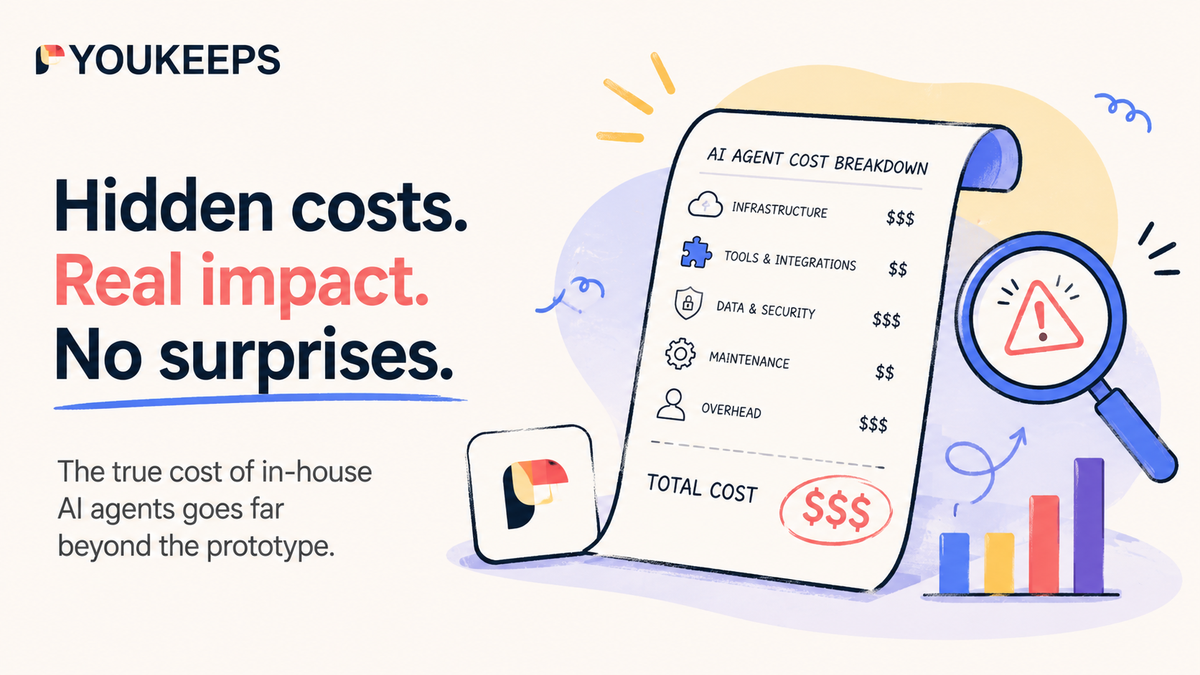
The real costs aren't in the prototype. They're in everything that comes after.
Gartner predicts that over 40% of agentic AI projects will be canceled by the end of 2027. Rising costs, unclear value, security risks. Watching what's happening across the market, we wouldn't be surprised if the actual number ends up higher.
We talk to enterprise teams building AI agents every week. The pattern is remarkably consistent. The prototype works. The demo goes well. And then reality shows up.
Here's what we see getting underestimated most often.
1. Token costs look cheap today. They won't stay that way.
While providers hand out tokens as part of promotional packages, everything looks affordable. But promos end.
According to Zylo, 65% of IT leaders already face unexpected costs from token consumption. A typical product with 1,000 daily users burns through 5 to 10 million tokens per month. That's just one agent, one use case.
The question nobody asks early enough: who's going to optimize this?
And there's a bigger issue on the horizon. As global token consumption grows, compute capacity will start running short. When that happens, AI costs go up across the board. The pricing you see today is not the pricing you'll be paying in 18 months.
2. Scenarios don't simplify. They multiply.
Let's say you build an agent for scheduling university lectures. It works for the basic case. Great.
Now it needs to handle rescheduling, substitutions, vacations, room conflicts, time zones, public holidays, part-time staff with non-standard availability. Every "simple" scenario, once it meets real users in a real environment, branches into dozens of edge cases.
Without a clear roadmap for expanding scenarios over time, you end up with an agent that gives wrong answers. Users lose trust. And here's the part that hurts most: they don't just lose trust in that specific agent. They lose trust in AI altogether. After a bad first experience, getting the same team to adopt a properly built product becomes exponentially harder. The damage is done.
3. Security isn't a checkbox. It's an ongoing process.
"Our data is processed internally, so it's secure." We hear this a lot. But the numbers tell a different story.
Employees leak data without realizing it. According to Cyberhaven, 39.7% of employee interactions with AI tools already involve sensitive data. Source code, financial reports, client databases, strategic documents — pasted into public AI platforms not out of malice, but simply to get work done faster.
Shadow AI is expensive. IBM found that organizations with high levels of shadow AI pay $670,000 more per data breach. The average incident cost hits $4.63 million.
Most companies have no AI security policies. CyberArk reports that 68% of organizations have no security policies specifically covering AI technologies.
AI agents are becoming the top insider threat. Palo Alto Networks named AI agents the number one insider threat for 2026. A single prompt-injection attack can give an adversary an autonomous insider capable of executing transactions, deleting backups, or exfiltrating an entire client database.
Even Microsoft isn't immune. Microsoft confirmed a bug in Copilot Chat that generated summaries of confidential emails, bypassing DLP policies entirely.
And then there's something that isn't about hacking at all, but causes just as much damage.
The problem nobody files a security ticket for: hallucinations
AI regularly forgets its own instructions, even in straightforward tasks. As scenarios get more complex, it starts behaving unpredictably.
From what we've seen firsthand: agents deleted mailboxes, misled users with fabricated information, and suggested payments that should never have existed.
These aren't rare edge cases. This is the day-to-day reality of working with AI agents without constant oversight and testing.
The average cost of insider incidents in 2025 was $19.5 million per organization (Ponemon Institute). And that's before agents went mainstream.
So who's auditing your in-house agents?
Gartner notes that out of thousands of vendors calling themselves "agentic AI," only about 130 have real capabilities. The rest is what they call "agent washing" — rebranded chatbots with a new label.
The question isn't whether you can build an agent. The question is whether you should.
Everything listed above is solvable. But solving it means essentially becoming an IT company focused on continuous AI agent development. Growing a team with deep AI and security expertise, keeping pace with ever-evolving challenges in token optimization, scenario coverage, and threat mitigation. For most corporations whose core business isn't AI, that means building a second company inside your own.
The alternative: buying from people who do this full-time
When you purchase an agent from a specialized vendor on a subscription basis, all of these challenges become the vendor's responsibility. That's their entire business:
- Token optimization — they work on reducing consumption continuously because their margins depend on it
- Scenario expansion — competition forces them to cover more use cases, faster
- Security and compliance — they go through Microsoft certification, SOC 2, ISO 27001, and often SAST/DAST audits required by enterprise clients
Are there risks with buying too? Of course. But they're of a fundamentally different nature. And they're far more manageable than trying to do everything yourself.
One more thing
In our work, we've encountered attack scenarios against in-house agents that aren't written about in public sources. We intentionally keep those details private. We'd rather not hand anyone a playbook or fall into the trap of self-fulfilling prophecies.
What we will say is this: if your company is considering building AI agents internally, make sure the people responsible for security actually have the expertise to evaluate the risks. Because the risks are real, they're growing, and they don't wait for your next quarterly review.
References:
- Gartner — Over 40% of Agentic AI Projects Will Be Canceled by 2027
- Azilen — AI Agent Development Cost Breakdown 2026
- Ponemon Institute — 2026 Cost of Insider Risks
- Palo Alto Networks — AI Agents as Insider Threat
About Youkeeps: We build an AI scheduling agent for enterprise, integrated with Microsoft 365 and Copilot. Learn more →