The ROI of an AI Scheduling Agent
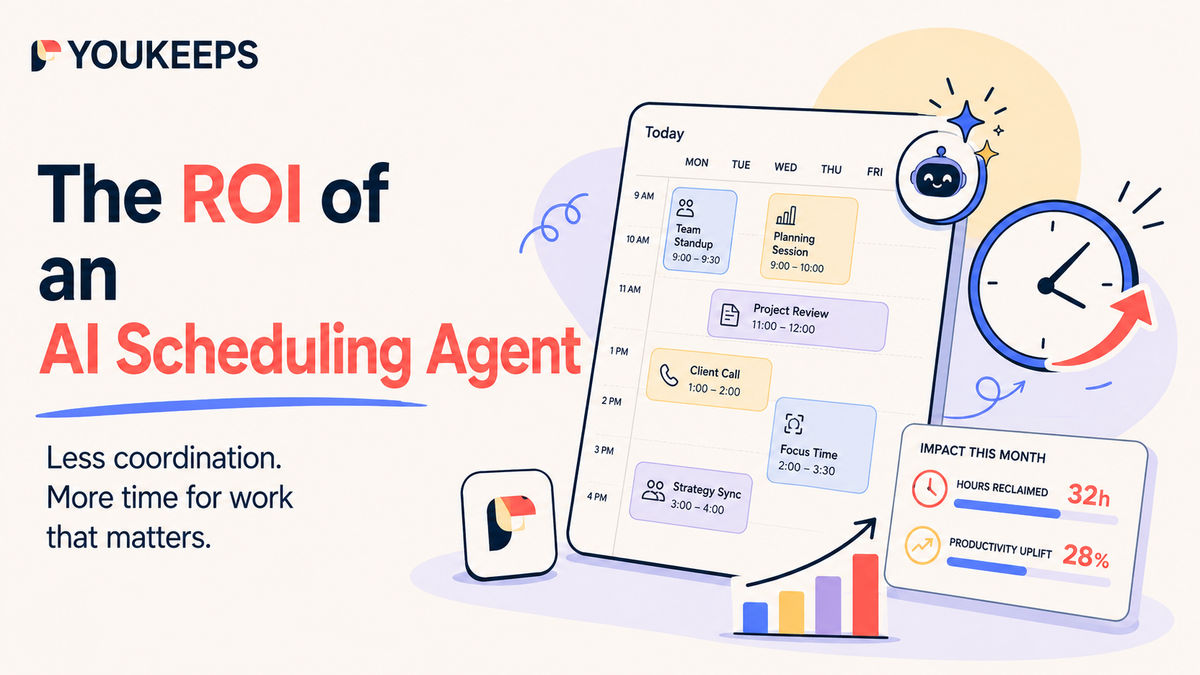
Scheduling looks like a five-minute task. It isn't. The average knowledge worker loses around 3 hours a week to coordinating meetings, and nobody tracks it. At $60 an hour, that's about $8,600 per person per year spent on emails, availability requests and reschedules.
The cost doesn't stop at one calendar. Move one meeting and you move the people, decisions and follow-ups that depend on it. Sales cycles stretch, hiring loops stall, projects wait.
This article shows how we calculate the ROI of Youkeeps, the assumptions behind every number, and what our customers actually measured. We kept the model deliberately conservative. You can check every step and run it on your own data.
The methodology: just four steps
Our ROI model counts one thing only: coordination time given back to employees. Everything else is upside, and we treat it separately.
- Coordination time per meeting. Effort grows with every participant. Doodle's controlled study of 96 people showed time and back-and-forth rise with group size. We model it as 10 minutes base, plus 4 minutes for each participant beyond two. A 5-person meeting = 22 minutes of coordination.
- Time saved. Youkeeps removes about half of that effort. We use 50% as the default, below what customers report (65% to 80%).
- Hours and money. Minutes saved per week × 48 working weeks × the employee's hourly cost.
- Against the cost. Compared with the Youkeeps price of $120 per user per year, for active users only.
Four rules keep the number honest:
- Active users, not licenses. A seat nobody uses returns nothing, so it doesn't count.
- Only coordination time. Faster deals, fewer no-shows and shorter hiring loops are real, but we don't add them to the ROI.
- A conservative saving rate. 50%, even though our case studies show 65% to 80%.
- Baseline first. In a pilot, we measure how long scheduling takes before Youkeeps, then compare.
What the numbers look like
Even a light user pays Youkeeps back almost three times over. Here are three profiles at a conservative $30 an hour and $120 per user per year:
Profile | Meetings / week | Participants | Coordination / meeting | Hours back / year | Value / year | ROI | Payback |
|---|---|---|---|---|---|---|---|
Light (individual contributor) | 2 | 3 | 14 min | 11 h | $336 | 180% | 4.3 months |
Typical (manager) | 6 | 5 | 22 min | 53 h | $1,584 | 1,220% | < 1 month |
Heavy (sales, presales, leadership) | 12 | 6 | 26 min | 125 h | $3,744 | 3,020% | < 2 weeks |
At $60 an hour, the value per user doubles. For a team of 40 typical users, that's about 2,100 hours a year, worth $63,000 at $30 an hour, for a $4,800 subscription.
What customers actually measured
The model is conservative. Real deployments beat it. Here's what customers in four different industries measured.
A value-added IT distributor (Latin America and the US). A client meeting used to take anywhere from 4 hours to 3 working days of emails. With Youkeeps it's confirmed within 1 hour.
- ~80% less time-to-schedule
- Organizers' scheduling time: 5 hours → 1 hour per week, about 190 hours a year back per organizer
- 88% of users save time every week; 60% weekly retention
- Presales: from up to 1 hour a day checking availability to 10–15 minutes
An integrator serving corporate clients across many time zones.
- 15+ hours a week reclaimed across the sales team
- 35% less time-to-meet
- 22% shorter deal cycle
A specialty pharma company working with regulators and partners across dozens of markets. Youkeeps was live in Teams within five minutes of the decision. The team now spends less time arranging meetings and more on partnerships and market access.
An enterprise pilot in global IT services. Users handed Youkeeps about one scheduling action per person per week. Even at that light pace, the subscription pays back in about 3 months at $50 an hour.
“Now our team has Youkeeps, and it just gets it done, directly inside MS Teams.” Customer, IT distribution
Beyond time saved: the value we don't count
Saved minutes are the floor. The bigger gains show up in how fast work moves, and they can only be measured on your own data:
Metric | What it measures | Customer result |
|---|---|---|
Time-to-schedule | Request sent → meeting confirmed | 65–80% faster |
Time-to-meet | Request sent → meeting held | 35% faster |
Reschedule rate | Share of meetings moved | Fewer exchanges per meeting |
Deal cycle | First contact → signed deal | 22% shorter |
A fair note on attribution: Youkeeps speeds up the coordination part of a deal or hiring cycle, not the whole cycle. That's why these metrics stay out of the ROI formula. We track them with you during rollout instead.
How to measure it yourself in two weeks
You don't need to take our word for it. A two-week pilot gives you your own numbers:
- Pick the most meeting-heavy team. Leadership, sales and presales show results fastest.
- Record a baseline. Ask the team how long it takes to confirm a typical meeting today, and how many they arrange per week.
- Install from Microsoft Marketplace. Youkeeps lives in Teams, so there's no new tool to learn. Setup takes minutes to 2 days.
- Track active use, not seats. Count scheduling actions per user per week.
- Compare after two weeks. Time-to-schedule, hours spent, and a short survey: did you save time?
- Plug the results into the calculator. You get your own ROI and payback, based on your data.
See your own number
Every team schedules differently, so your ROI will be yours. Three ways to find it:
- Run the ROI calculator. Move the sliders to match your meetings, team size and hourly cost. It takes about a minute. Open the calculator
- Start a free 2-week pilot. Install Youkeeps from Microsoft Marketplace and measure it on your own team, at no cost. Get it on Microsoft Marketplace
- Talk to us. We'll help you set a baseline and read the results. Book a discovery call
Meetings, scheduled. Deals, moving.